

Why does social media matter for local real estate agents?
Every day, potential clients are researching agents. Maybe even you.
They Google your name. Check your reviews. Scroll your social media. Compare you with three other agents. If your profiles look abandoned, inconsistent, or outdated, they won't tell you why they didn't call. They'll simply call someone else :(
according to the National Association of REALTORS®, 43% of home buyers begin their journey by searching online, and virtually every buyer uses the internet at some stage of the home-buying process. Your digital presence isn't just part of your marketing anymore it's part of your reputation.
What do potential clients want to see before reaching out?
Potential clients are not only looking for properties. They want to know whether you are active, credible, approachable, and relevant to their situation.
A strong real estate social media profile should answer these questions quickly:
- Do you work in the area I care about?
- Do you understand the type of property I want to buy, sell, rent, or lease?
- Do you explain things in a way I can understand?
- Do you have recent activity, or does your page look abandoned?
- Do you seem professional without feeling cold?
- Do you have proof of experience?
- Do you show real market knowledge, not just generic quotes?
- Do you make the process feel less confusing?
For luxury real estate agents, potential clients also want discretion, taste, and confidence. For commercial real estate agents, they want to see analytical thinking and business context. For vacation rental managers and leasing agents, they want to see reliability, local knowledge, and operational clarity.
This is why your content should not only show what you sell. It should show how you think.
A good post might explain why a home sat on the market longer than expected. Another might show what sellers often forget before photography day. Another might compare two types of buyers in the current market without making promises or overgeneralizing.
Which platforms are worth using?
The best platform depends on your market, your client type, and your capacity. Most Realtors do not need to be everywhere. They need to show up consistently where trust is built.
Instagram is usually the strongest platform for visual real estate content. It works well for property tours, local lifestyle content, short videos, Stories, Reels, carousels, and personal brand building.
Use Instagram when your business depends on:
- Residential buyers and sellers
- Luxury real estate
- Local visibility
- Relocation clients
- First-time buyers
- Design-forward properties
- Neighborhood storytelling
But do not make Instagram only about beautiful houses. A polished feed with no useful advice can feel empty. Balance visuals with education.
Realtors Getting Instagram Right:
Glennda Baker (Atlanta REALTOR): Famous for authentic storytelling and practical real estate advice delivered with humor and personality rather than polished sales content.
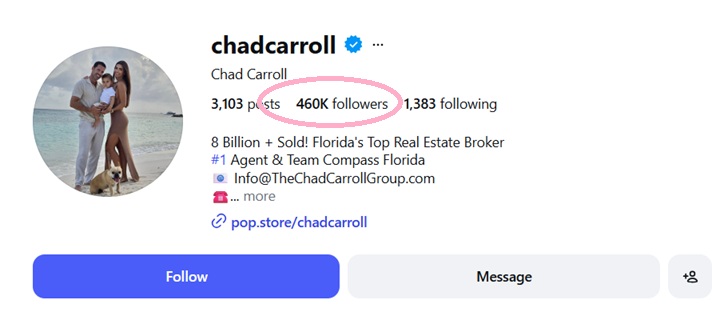
Chad Carroll (Florida's Top Real Estate Broker) His luxury listing videos are highly cinematic while still keeping Chad himself front and center, creating a recognizable personal brand.
Facebook still matters for local real estate, especially for community visibility, local groups, older homeowners, referrals, and neighborhood conversations.
It is useful for:
- Local market updates
- Open house reminders
- Community posts
- Seller education
- Client stories
- Real estate teams serving specific towns or suburbs
Facebook is also where people often tag friends and family. A helpful post about preparing a home for sale can travel further than a generic listing announcement.
Realtors Getting Facebook Right:
Jamie Combs: Jamie has built her business almost entirely through authentic social media, mixing market education with relatable day-to-day content instead of polished listing ads
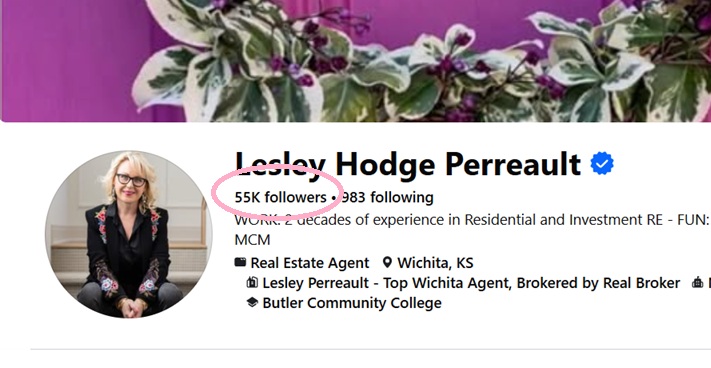
Lesley Hodge Perreault (Residential and Investment RE): A top Wichita, KS agent who became one of the most-followed individual realtors on Facebook by mastering Reels before they were mainstream, combining two decades of residential expertise with a warm, camera-confident personality that drives consistent engagement.
LinkedIn is valuable for real estate brokers, commercial real estate agents, luxury agents, referral partnerships, investors, relocation work, and professional credibility.
It works well for:
- Market commentary
- Commercial property insights
- Investment lessons
- Professional milestones
- Deal process stories
- Business owner education
- Referral network building
If you work with business owners, investors, developers, executives, or high-net-worth clients, LinkedIn should not be ignored.
Realtors Getting Linkedin Right:
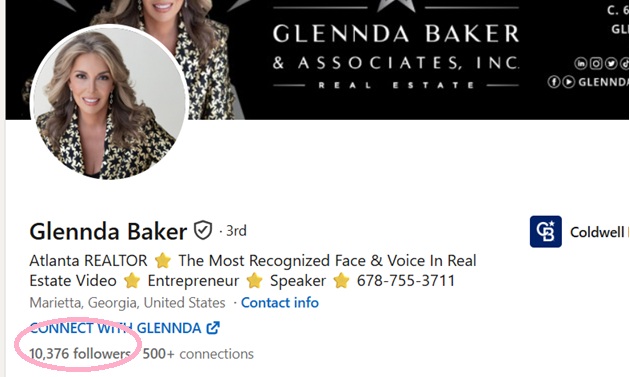
Glennda Baker her LinkedIn presence extends her brand to a professional audience, reinforcing her authority as a speaker, coach, and top-producing agent.
TikTok and YouTube Shorts
Short-form video is powerful when you can explain clearly and show personality. You do not need to dance, act, or chase trends.
Good real estate short videos include:
- “Three things buyers misunderstand about inspections”
- “Why this listing price looks high but may not be”
- “What I would check before buying in this building”
- “A 30-second tour of this neighborhood”
- “One mistake sellers make before photos”
Video builds trust faster because people hear your voice, see your confidence, and understand your communication style.
Google Business Profile
Most real estate agents think of their Google Business Profile as a directory listing. The best agents treat it like another social media channel.
Every new review, market update, listing photo, or answered question tells Google and potential clients that you're active in your local market.
Remember, referrals don't happen in a vacuum. When someone says, "Call Sarah she sold our house," the next step usually isn't picking up the phone. It's Googling your name. In a matter of seconds, they'll scan your reviews, photos, recent posts, and activity to decide whether you still look like the right agent.
When someone searches "real estate agent near me," you want to look like the obvious choice.
The best content pillars for Realtors
A good content strategy needs structure. Without pillars, most agents fall back to listings, closing photos, and random market updates.
For real estate agencies, solo realtors, and teams, I usually recommend these core pillars.
1. Market education
Explain what is happening in the local market in plain language.
Do not just say, “Inventory is up.” Explain what that means for buyers, sellers, pricing, negotiation, and timing.
- “What rising inventory means for sellers in this area”
- “Why some homes still sell fast while others sit”
- “What buyers should know before making a low offer”
- “How interest rates affect monthly payment, not just price”
2. Neighborhood knowledge
Real estate is local. Show that you understand the streets, buildings, schools, commute patterns, lifestyle, parking, noise, development, and buyer behavior in your market.
Be careful not to describe neighborhoods in ways that could create fair housing issues. Focus on property features, amenities, commute, market data, architecture, local businesses, and practical lifestyle factors.
3. Process guidance
Clients are anxious because the process is confusing.
Content that explains the process builds confidence.
- “What happens after an offer is accepted”
- “What sellers should prepare before listing”
- “What buyers should ask during a showing”
- “What happens during inspection”
- “How pricing strategy is built”
4. Listings and property stories
Listings are important, but they should not be the whole strategy.
Instead of posting “3 bed, 2 bath, call me,” tell the story of the property. Highlight layout, light, renovation choices, outdoor space, investment potential, location benefits, or what makes the property different.
5. Proof and trust
Proof does not always mean showing off. It can be practical.
Use:
- Client questions you answered
- Problems you solved
- Before and after preparation
- Negotiation lessons
- Review highlights
- Case-study style posts
- “What we learned from this transaction” posts
6. Personal professional presence
People hire people. Your feed should show some of your personality, but it should still support your positioning.
You do not need to post your whole private life. Share enough to feel human.
This can include:
- Why you work in this market
- Local places you genuinely like
- Your workday behind the scenes
- Lessons from clients
- Community involvement
- Your values as an agent
A luxury agent once asked me why her page looked expensive but did not bring conversations. The issue was not the visuals. It was that every post felt like a magazine ad. We added short captions about decision-making, seller preparation, buyer psychology, and local context. Her feed still looked premium, but it finally sounded like an expert was behind it.
Post ideas
Most Realtors know they should post more often. The harder question is what to post when there is no new listing, no closing, and no dramatic market update.
Here are practical post ideas you can rotate.
Educational Posts
- "Why two nearly identical homes in Scottsdale sold $80,000 apart."
- "What I tell every first-time buyer before touring homes in Charlotte."
- "Why the highest offer isn't always the best offer in today's market."
- "Three inspection issues I keep seeing in homes built during the 1980s."
- "Should you renovate your kitchen before listing? It depends on your ZIP code."
- "What buyers misunderstand about HOA fees in Las Vegas."
- "How much does an extra garage actually add to resale value in my market?"
Hyper-Local Posts
These often outperform listing photos because they prove you know the area.
- "Why so many families are moving from Brooklyn Heights to Park Slope."
- "Coffee shops my clients always ask about after buying in East Nashville."
- "Is Downtown Austin still worth buying in during 2026?"
- "Five things newcomers should know before moving to Gilbert, Arizona."
- "The busiest open-house streets in Coral Gables this month."
- "What's changing around the new light rail station and what it could mean for nearby home values."
- "A Saturday morning walk through Old Town Alexandria."
Listing Stories
Don't just post the listing—tell the story behind it.
- "Why every visitor stops in the kitchen first."
- "The biggest challenge we solved before bringing this home to market."
- "Three details the professional photos don't capture."
- "Why we intentionally priced this home below recent comparable sales."
- "The question every buyer asked during Sunday's open house."
- "What made this home receive multiple offers in three days."
Trust-Building Posts
The best Realtors teach people how they think.
- "I told my client not to buy this house. Here's why."
- "The biggest mistake I helped a seller avoid this week."
- "Why I advised my buyers to walk away after the inspection."
- "A negotiation that saved my client $18,000."
- "What I look for before recommending a neighborhood."
- "What Zillow can't tell you about this part of town."
- "The conversation I have with every first-time buyer."
Short Video Ideas
These are quick, authentic videos that consistently perform well.
- "A 30-second market update for Tampa."
- "What $750,000 buys in Denver today."
- "Let's walk one block down King Street."
- "Three things buyers always miss during an open house."
- "One feature that makes this home different from every other listing nearby."
- "Would I buy this investment property? Here's my honest analysis."
- "The most underrated neighborhood in San Diego right now."
When I create content calendars for real estate agents, I usually avoid filling the week with random ideas. I connect each post to a business goal: attract sellers, educate buyers, build local authority, support a listing, or create referral trust.
That keeps the content useful instead of noisy.
How should you handle trust, compliance, and reputation?
Real estate content carries more risk than many other industries because it touches housing, money, legal process, advertising rules, and client expectations.
Before posting, make sure your language, targeting, and visuals respect fair housing rules, brokerage requirements, MLS rules, and local advertising laws.
Be especially careful with:
- Describing who a home is “perfect for”
- Making claims about schools, safety, crime, or demographics
- Using photos or music you do not have rights to use
- Sharing client details without permission
- Posting testimonials, reviews, or endorsements without proper context
- Making guarantees about price, timing, appreciation, rental income, or investment return
- Comparing neighborhoods in ways that could sound exclusionary
This does not mean your content has to be boring. It means your content should be precise.
Instead of saying “perfect for young families,” talk about property features: “three bedrooms on one level,” “fenced backyard,” “near public parks,” or “open kitchen and living area.”
Instead of saying “safe neighborhood,” talk about walkability, lighting, building access, transit, or local amenities.
Instead of promising “this home will sell fast,” say “homes with similar features have attracted strong attention recently, but pricing and timing depend on current market conditions.”
Good marketing does not need risky language. It needs clarity.
Common FAQ we get
How often should real estate agents post on social media?
Three to five times per week is a good starting point. Consistency matters more than posting every day and burning out.
What should I post if I do not have listings?
Post buyer tips, seller advice, neighborhood insights, market explanations, client questions, and behind-the-scenes work. Your expertise is content.
Should Realtors use video?
Yes, if possible. Short videos help people hear your voice, understand your style, and trust you faster.
Is Instagram better than Facebook for real estate agents?
Instagram is usually stronger for visual discovery, while Facebook is still valuable for local relationships and referrals. Many agents benefit from using both.
Can social media actually bring real estate leads?
Yes, but usually through trust over time, not instant sales. Strong content supports referrals, repeat business, and direct inquiries.
How do I avoid sounding too salesy?
Teach more than you promote. If most of your posts help people make better decisions, your sales posts will feel more natural.