
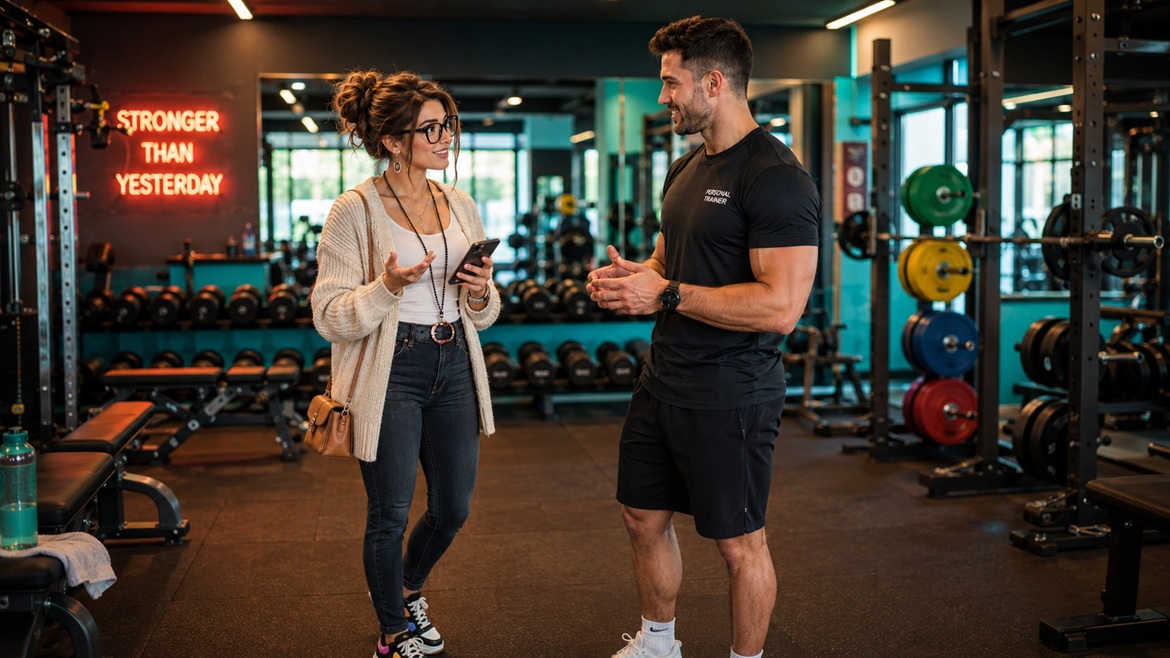
If you are a personal trainer, you have probably answered the same questions hundreds of times: “How do I lose belly fat?” “How often should I train?” “Why am I not seeing results?” Those answers are not just coaching—they are content.
Or, if you have ever corrected the same squat mistake five times in one week, you already have a post idea. Social media marketing starts with noticing what you teach every day.
I spend my days analyzing how fitness professionals attract clients online. The truth is, most trainers overcomplicate social media. You do not need to be a professional videographer or a fitness influencer with millions of followers. You just need a system to turn your daily expertise into a client-generating machine.
Let me show you exactly how to make social media work for your fitness business.
Standing Out in a Crowded Fitness Market
The personal training industry is growing fast. The U.S. Bureau of Labor Statistics projects a 12% employment growth in fitness training through 2034, which is much faster than the average for all occupations. With roughly 340,000 certified personal trainers working in the U.S. alone, the competition for local clients is fierce.
In my experience working with solo business owners, I see many trainers relying entirely on gym walk-ins or word-of-mouth. While referrals are powerful, they are not always predictable. Social media bridges that gap. It allows you to build trust before a prospect even steps foot in the gym.
When a potential client is looking for a private trainer, they almost always check Instagram or Facebook first. They want to see your training style, hear your coaching philosophy, and look for proof that you can get results. If your profile is empty or confusing, they will move on to the next trainer. Social media is your digital storefront, and for 90% of fitness professionals, it is their primary marketing tool.
What's Holding Most Personal Trainers Back?
Time, time, and again, time. It's the challenge personal trainers mention more than anything else. Between early morning sessions, program design, and managing clients, sitting down to plan a content calendar feels impossible.
Another major hurdle is knowing what to post. Many trainers default to posting generic workout selfies or pictures of their lunch because they do not have a clear strategy. They post sporadically, see low engagement, and conclude that social media does not work for their business.
Finally, there is the fear of being "salesy." You became a fitness coach to help people, not to be a pushy salesperson. The good news is that the best social media marketing for personal trainers does not feel like selling at all. It feels like teaching.
I recently started working with a private trainer who was exhausted from trying to post every day. She was spending hours filming complex workouts that got zero local traction. I shifted her strategy to focus entirely on answering the specific questions her current clients asked during sessions. By simplifying her approach and taking over the scheduling, she saved four hours a week and signed three new local clients in the first month.
Best Platforms Fitness Coaches
Trying to manage five different accounts is a guaranteed recipe for burnout. You do not need to be on every platform. Pick one or two platforms where your ideal clients spend their time and master them.
Instagram: The Visual Portfolio
Instagram remains the powerhouse for fitness marketing. It is highly visual, making it perfect for demonstrating form, sharing client transformations, and giving quick tips. The platform's mix of Reels for reach and Stories for daily connection allows you to build a well-rounded brand. According to recent data, 81% of fitness enthusiasts transition to online workouts or programs after seeing an Instagram ad or post.
Facebook: The Community Builder
Do not write off Facebook. While organic reach on business pages has dropped, Facebook Groups are incredible for community building. Furthermore, Facebook is often where older, higher-paying demographics spend their time. If your target audience includes busy professionals or seniors, Facebook is essential.
TikTok: The Reach Engine
If you want to reach a massive audience quickly, TikTok is the place to be. The algorithm is excellent at matching specific content with interested users. A quick 15-second video explaining a common deadlift mistake can easily reach thousands of people. Keep in mind that TikTok audiences skew younger, so ensure this aligns with your ideal client profile.
Content Pillars That Build More Than Muscle :)
To avoid the stress of figuring out what to post every day, you need content pillars. These are 3–4 core themes that represent your brand. Every post you create should fit into one of these pillars.
Education and Value
This should make up the bulk of your content. Teach your audience something useful. Break down complex fitness concepts into simple, actionable advice. Explain the difference between a Romanian deadlift and a conventional deadlift. Share a quick mobility routine for desk workers.
Proof and Transformations
Show, do not just tell. Client success stories are your best marketing asset. Share before-and-after photos, but more importantly, share the story behind the transformation. What struggles did the client overcome? How did your coaching help them get there?
Behind the Scenes
People buy from people they like and trust. Show your audience what your day looks like. Share your own workouts, your meal prep, or even your struggles with motivation. Vulnerability builds connection.
Promotion
You still need to tell people how they can work with you. Once you have provided value, built trust, and shown proof, clearly explain your services. Whether you are launching a new boot camp or have two spots open for one-on-one coaching, make the call to action direct and easy to follow.
Post Ideas for Trainers
If you are staring at a blank screen, try these specific post ideas to get started:
•The Myth Buster: Take a common fitness myth (e.g., "lifting weights makes women bulky") and explain why it is wrong in plain English.
•The Form Check: Record a quick video showing the wrong way and the right way to perform a popular exercise like a lunge or a push-up.
•The Grocery Haul: Show your audience what you actually buy at the supermarket. Explain why you chose certain items over others.
•The Client Spotlight: Highlight a client who hit a major milestone, whether it is a personal best on a lift or finally running a 5K without stopping.
•The Quick Win: Share a 5-minute stretching routine that people can do right at their desks.
How to Become the Go-To Trainer in Your Area
If you run an in-person business, having 10,000 followers in another country does not help your bottom line. You need local eyes on your content.
First, use local geotags on every single post and Story. Tag your gym, your city, and popular local landmarks. This tells the algorithm to show your content to people in your area.
Second, engage with other local businesses. Leave genuine comments on posts from the local coffee shop, physical therapist, or running store. Building a digital referral network often leads to real-world clients.
Finally, use highly specific local keywords in your profile bio and captions. Instead of calling yourself a "Personal Fitness Coach," use "Personal Fitness Coach in [Your City]." Make it incredibly easy for local prospects to find you when they search.
I manage the social media for a solo business owner who runs a small private studio. He had great content but no local reach. I started tagging the neighborhood coffee shop and the local park in his posts. I also optimized his bio to clearly state his neighborhood. Within three weeks, his profile visits from local accounts tripled, leading to a steady stream of local inquiries.
The 2026 fitness trends personal trainers should turn into content
A good social media strategy should not chase every trend, but it should understand what clients are already thinking about.
ACSM’s 2026 fitness trends put wearable technology at number one, followed by fitness programs for older adults, exercise for weight management, mobile exercise apps, and balance, flow, and core strength. ACSM also notes that nearly half of U.S. adults now own a fitness tracker or smartwatch.
That gives personal trainers a huge content opportunity.
Turn wearable data into content.
Many clients have more data than they know what to do with. They see heart rate zones, recovery scores, sleep reports, step counts, calories burned, VO2 max estimates, and stress metrics. Then they either ignore the numbers or obsess over them.
A personal fitness coach can help people interpret the data without overpromising.
Useful wearable-content topics include:
- “What heart rate zones actually mean for beginners”
- “Why your watch calorie estimate is not a perfect number”
- “How to use step count as a consistency tool”
- “What to do when your recovery score is low”
- “Why sleep affects your workout more than motivation does”
- “How to stop letting your smartwatch ruin your mood”
- “When wearable data helps, and when it becomes noise”
- “Why older adults should care about balance, strength, and daily movement”
The older-adult trend is also important. Many trainers still market as if fitness only belongs to young people chasing aesthetics. That is a mistake.
Adults in their 50s, 60s, and beyond often want strength, independence, balance, confidence, bone health, energy, and the ability to enjoy life. They may not care about your most extreme workout.
They care whether you can help them move better without making them feel embarrassed.
Weight management content also needs more maturity. People are tired of shame-based fitness. Strong trainers can talk about weight goals while also discussing strength, habits, lean mass, metabolic health, energy, and self-respect.
That tone matters.
Common FAQ We Get
How often should a personal trainer post on social media?
Aim for consistency over volume. Posting 3–4 high-quality times a week is much better than posting every day with no strategy.
Do I need to pay for social media ads to get clients?
No. You can build a full roster of clients using organic content, local networking, and clear calls to action before ever spending money on ads.
What is the best time of day to post fitness content?
Post when your ideal clients are looking at their phones. For busy professionals, this is usually early morning, during lunch breaks, or in the evening after work.
Should I have separate personal and business accounts?
Yes. Keep your business account focused entirely on providing value to your target audience, and save the personal account for family and friends.
How do I convert followers into paying clients?
Provide consistent value, show proof of your results, and regularly remind your audience exactly how they can hire you or join your programs.